Scientists from the Department of Physics have succeeded in preparing ultrathin scandium carbide using magnetron sputtering
Scientists from the Department of Physics at the Faculty of Science, Jan Evangelista Purkyně University in Ústí nad Labem, in collaboration with Lodz University of Technology (Poland) and Charles University in Prague, have succeeded in preparing an ultrathin phase of scandium carbide using magnetron sputtering.
Two-dimensional metal carbides, known as MXenes, exhibit unique properties due to their extremely small thickness and offer promising applications in electronics, energy-related technologies, and sensing. Theoretical studies attribute semiconducting behavior and unusual optical properties to two-dimensional scandium carbide, which distinguish it from other materials in this group. In practice, however, its demanding synthesis has so far limited its experimental investigation.
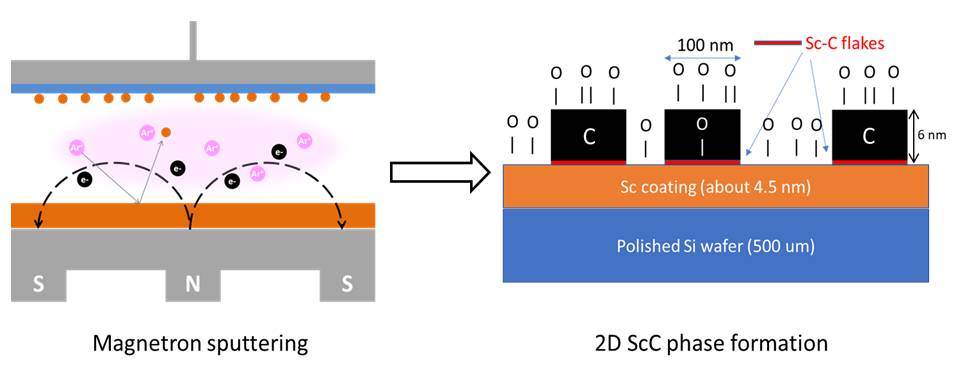
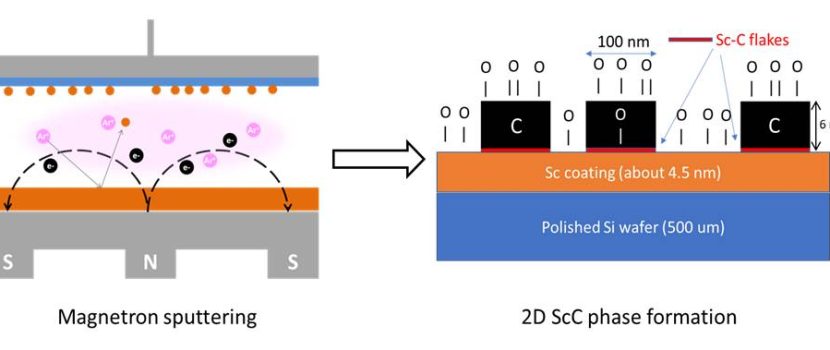
This challenge was addressed by researchers from the Department of Physics, who successfully adapted an alternative physical method—magnetron sputtering—for the preparation of an ultrathin scandium carbide phase at the interface between scandium and carbon layers.
The research shows that magnetron sputtering may represent a promising route for producing unconventional two-dimensional materials that cannot be easily obtained using standard approaches. The formed scandium carbide structures could find future applications in optoelectronics, sensing, or energy storage technologies. The work of the UJEP team thus contributes not only to a better understanding of this material but also to the development of new experimental approaches in modern materials physics.
The results of this study were published in the prestigious journal Applied Surface Science.
A. Jagerová, M. Kormunda, M. Běloušek, P. Sláma, L. Bajtošová, A. Jędrzejczak, Formation of novel scandium carbide phase in scandium based bilayers deposited by magnetron sputtering, Applied Surface Science 723 (2026) 165661. https://doi.org/10.1016/j.apsusc.2025.165661